

Make identity verification
part of the product flow.
MeVerify provides a consistent layer for adding supported identity checks to onboarding, customer review and other risk-sensitive workflows without building a separate integration pattern for every verification source.
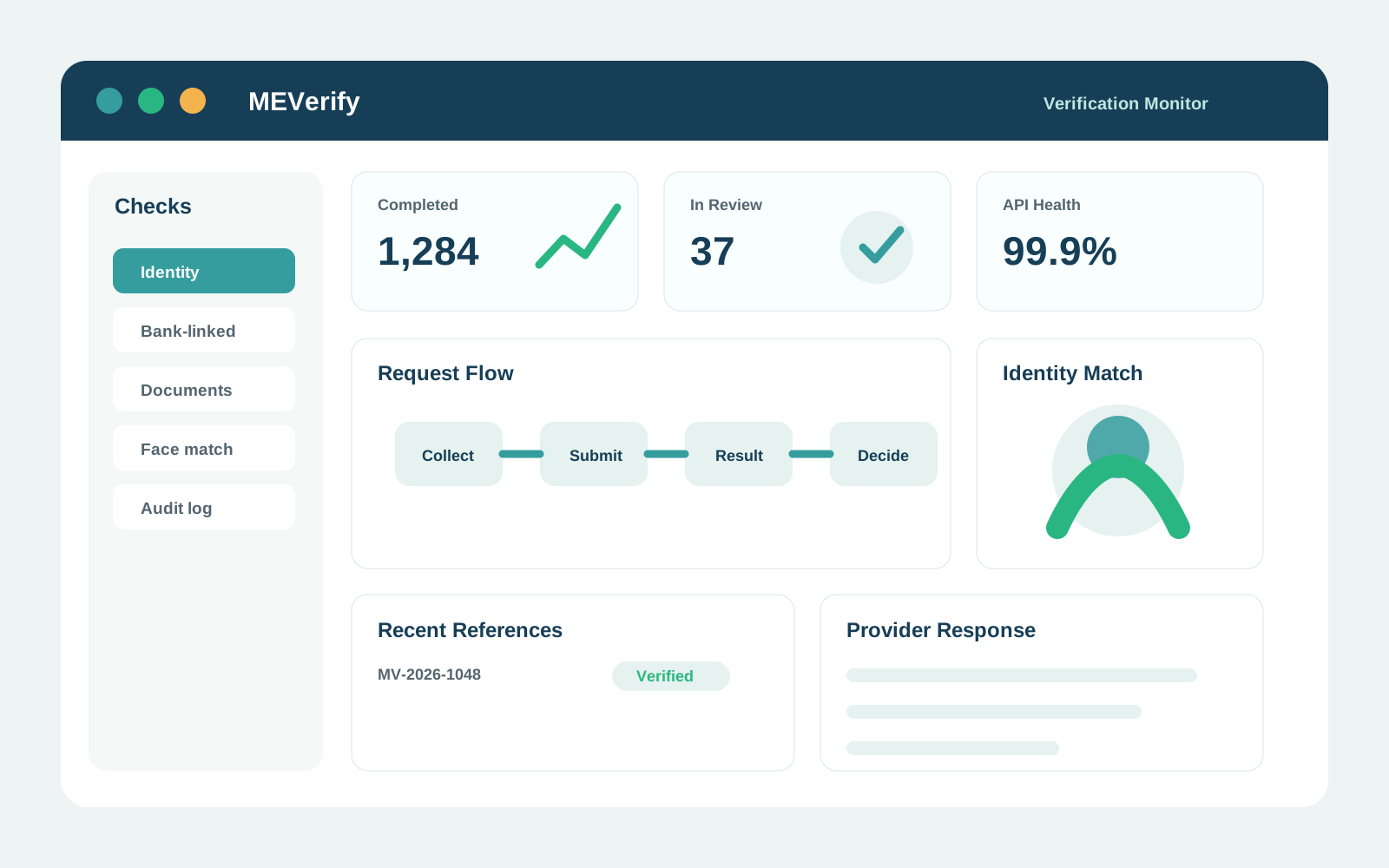
Identity checks
Request status
Reference tracking
API integration
Integration
Consistent request and response flow
Traceability
Request references and status visibility
Controls
Team access and operational review
Product use
Onboarding and risk-sensitive workflows
Identity should not become an
integration maze.
Different providers may return different structures, errors and statuses. Without a clear verification layer, engineering and operations teams spend time interpreting integrations instead of improving the customer journey.
Reduce integration inconsistency
Connect your application to a defined verification flow with structured requests, statuses, references and error handling instead of exposing every upstream difference to the product.
Give operations visibility
Teams can trace verification activity, review request status and follow a reference when investigating a customer issue or implementation problem.
One flow from request
to product decision.
MeVerify supports the verification step. The organisation remains responsible for its consent, customer-risk, retention, review and final decision policies.
01
Collect
Capture the information required for the selected check with appropriate customer notice and validation.
02
Submit
Send the verification request through the supported MeVerify integration method.
03
Receive
Obtain a structured status, reference and relevant result information for the check.
04
Decide
Continue, request another step, route for review or stop the action according to the organisation’s policy.
Supported verification
categories.
Availability depends on the current endpoint catalogue, provider connections, configuration and approved commercial scope.
Bank-linked identity
Supported identity checks using approved bank-linked information where the relevant service is available.
National identity
Supported national identity checks using the fields and provider connections available for the deployment.
Identity documents
Supported document-number checks and returned identity information for relevant document types.
Face and liveness
Biometric comparison or liveness workflows where enabled and appropriate for the use case.
Useful to engineering and
operations.
Identity infrastructure should not give developers an API while leaving customer-support and compliance teams unable to understand what happened.
For engineering teams
- Defined authentication and request patterns.
- Documented endpoints and implementation examples.
- Consistent result and error conventions.
- Reference identifiers for investigation.
- Test and live environments where provided.
- Asynchronous handling where supported.
For operations teams
- Verification request and status visibility.
- Search using available request references.
- Team access controls.
- Usage visibility where enabled.
- Support investigation tied to a request.
- Review or export workflows where available.
A result the product can
act on.
The current API documentation remains the source of truth for exact field names, authentication, statuses and error structures.
Designed for clear workflow handling
A useful verification response should help the application understand whether processing completed, what reference belongs to the request, what outcome was returned and whether another action is required.
Response concepts
Status
Whether the request completed, remains in progress or requires another handling path.
Reference
An identifier used to trace the request during support, investigation or reconciliation.
Result
Relevant verification information returned for the selected check.
Error context
Information that helps the application distinguish invalid data, unavailable processing and other failure conditions.
Integration without the
mystery phase.
A responsible rollout considers the technical flow, customer experience and operational response before live verification begins.
01
Define the check and policy
Establish what information is required, when verification is triggered and how each result affects the product workflow.
02
Review data handling
Clarify notice, consent, transfer, storage, access, retention, deletion and review responsibilities.
03
Build and test
Implement successful checks, mismatches, unavailable results, timeouts, retries, customer messaging and manual-review paths.
04
Prepare operations
Confirm credentials, access, monitoring, billing, support, escalation and investigation procedures.
05
Launch gradually
Monitor request outcomes, customer drop-off, repeated errors and operational workload as usage expands.
Privacy and security belong in the
product design.
The implementation review should establish how identity information is collected, transmitted, accessed, retained and handled when something goes wrong.
Lawful use
Define the purpose, lawful basis, customer notice and consent approach required for the workflow.
Data minimisation
Collect and transmit only the information required for the selected verification step.
Credential handling
Protect API credentials, secrets and privileged access through appropriate operational controls.
Access control
Restrict sensitive verification information to authorised users and relevant operational roles.
Retention
Define how long verification information and related records are retained and when they are deleted.
Use identity checks where the
risk requires them.
The exact check, timing and outcome policy should reflect the organisation’s product, risk model and customer journey.
Fintech onboarding
Verify required identity information before activating accounts, limits or higher-risk product features.
Lending
Add identity checks to applications, account linking, approval or disbursement controls.
Financial institutions
Bring identity results into customer creation, profile review and exception workflows.
Marketplaces
Strengthen trust-sensitive actions involving sellers, buyers, agents or service providers.
Workforce onboarding
Verify required identity information for employees, contractors, agents or partners where appropriate.
Risk-sensitive actions
Introduce an additional identity step before selected account changes, transactions or access decisions.
MeVerify inside the
Pintop stack.
Verification results can support broader customer, employee and operational workflows across Pintop platforms and custom integrations.
CoreWave CBA
Bring supported identity results into customer onboarding and profile-review workflows within the banking core.
CoreWave 360
Add supported checks to relevant employee, partner, agent or customer workflows.
Pintop Services
Build mobile, web, agent, partner and back-office experiences around the verification flow.
Frequently asked
questions.
Current check availability, testing access and commercial terms are confirmed through the product documentation and implementation process.
See the verification flow using your onboarding journey.
Bring the identity check, customer data, decision path, review process and integration questions your product needs. The walkthrough will focus on the supported flow and the work required to implement it responsibly.